
Readers' Views About Malli Stories from Mulki, Karnataka
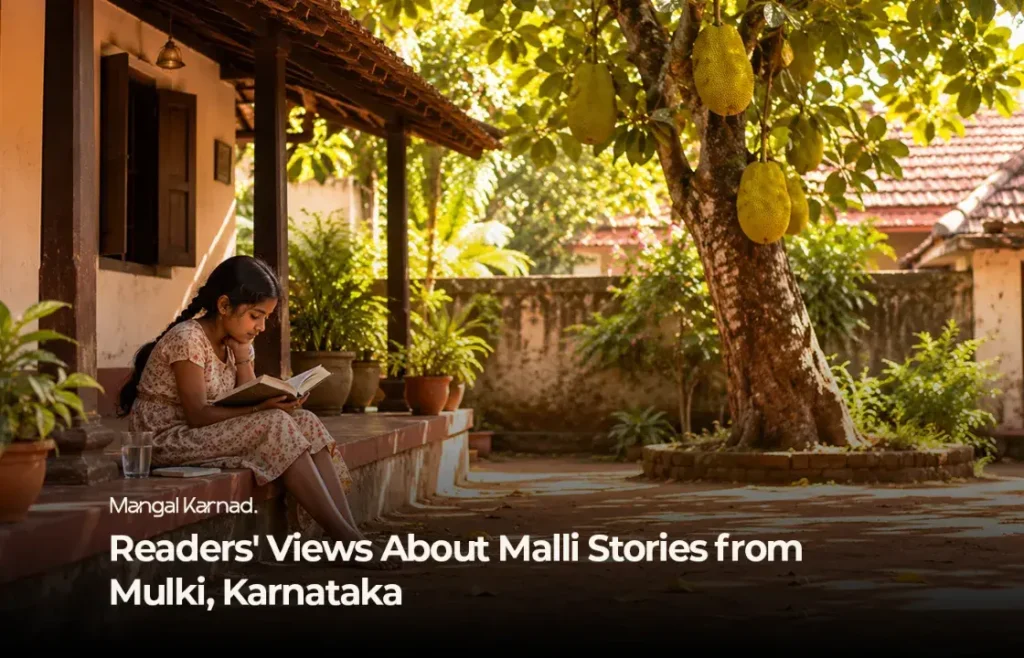
Over the past few weeks, I have received varied responses from readers of Malli and the Mulki Stories. Some wrote after reading a few chapters. Some responded to particular stories. Some spoke about Mulki, and many others spoke about their own childhood memories.
When I began writing these stories, my intention was to preserve memories from my own growing years. The courtyard and the games we used to play, the teasing and fights between friends, the falls from compound walls, the family routines, the festivals, and the small nuances of rural life were all part of a world I had known closely.
My stories were rooted in Mulki, Karnataka. What I had not expected was how often they would take readers back to places of their own.
I wrote the book for children over 6, but most seniors lapped up the stories as they recalled their childhood memories.
A reader once wrote that the book brought back memories of a cousin’s wedding that took place in her childhood. Another said that although the book may be meant for children, it is for adults too, especially for a generation that can relive an era that may not return.
Those responses made me pause. Perhaps stories travel in ways the writer cannot plan.
Why Do Stories from Mulki, Karnataka, Bring Back Memories?
Mulki, Karnataka, is the setting of these stories.
The tiled houses, courtyards, trees, school routines, neighbors, cousins, grandparents, kitchens, festivals, and village paths are not decorative details. They shaped the childhood I remember, and therefore, they shaped Malli’s world too.
When readers respond to those details, they are not always responding to Mulki alone.
They may be remembering their own courtyards, their own playgrounds, their own relatives, or their own childhood freedoms.
That is the interesting thing about specific places.
The more honestly they are remembered, the more easily they seem to open other memories.
I have often felt that if a story tries to be universal, it becomes vague. But when a story stays true to one place, one time, and one emotional truth, it connects people.
What Do Readers Notice in Childhood Stories with Moral Depth?
One reader, Mrs. Usha, wrote about the ease of the narration and the way the stories describe the small absurdities of bygone rural life. I liked that phrase because many of the incidents in the Malli stories are exactly that, small, ordinary, sometimes absurd, and yet difficult to forget.
Childhood is not always made up of grand lessons.
Sometimes it is a monkey entering a house and creating chaos. Sometimes it is a child taking a dare too seriously. Sometimes it is the embarrassment of being corrected, the courage of trying again, or the understanding that comes only after a mistake.
These are childhood stories with a moral, but the moral is not meant to stand outside the story. It is meant to grow from within it.
I have never wanted Malli to become a child who exists only to teach a lesson. She had to remain believable. She had to be curious, impulsive, brave, competitive, affectionate, and sometimes careless, because children are often many things at once.
If readers recognize that, then they have understood something central to the book.
When a Book Written for Children Reaches Adults
One of the most meaningful responses I received was that the book, though written for children, is also for adults.
I had thought about this while writing.
Children may enjoy the incident first. They may notice the monkey, the fall, the teasing, the game, or the adventure. Adults notice other things. They notice the doctor’s fee, the quiet labour of mothers, the presence of grandparents, the rhythm of joint families, and the kind of freedom children once had to play and learn without everything being organized for them.
A child reads the story forward.
An adult often reads it backward, through memory.
This is perhaps why some readers said the stories helped them relive an era. The stories may belong to Mulki, Karnataka, but the emotional memory they carry is not limited to one town.
It belongs to anyone who remembers a childhood shaped by family, neighbourhood, festivals, mischief, and small lessons that arrived slowly.
Why Mulki, Karnataka, Remains Central to Malli
I cannot separate Malli from Mulki, Karnataka.
If Malli had grown up elsewhere, she would have been a different child. Her games would have been different. Her fears would have been different. Her surroundings would have taught her differently.
Place has a way of entering children subtly.
The courtyard teaches negotiation. The tree teaches both courage and caution. Festivals teach anticipation and belonging. Older siblings teach competition. Grandparents teach authority and affection in the same breath.
Much later, when one writes about these moments, one realises that the place was never passive. It was participating all along.
That is why I continue to return to Mulki, Karnataka, in these stories. It holds not only the incidents, but the emotional weather of the childhood I am trying to preserve.
What Reader Responses Have Helped Me See
Dr. Swetha Raghunathan described Malli and the Mulky Stories as finely crafted tales that connect with the heart and bring out authentic lived experience. That response was reassuring because authenticity was more important to me than polish.
I wanted the stories to feel lived, not manufactured.
Another reader mentioned the closing section, What Malli Learned, and felt that the final thought works when it is left simply. I found that useful because childhood learning is rarely dramatic. A child does not always announce, “I have now learned courage” or “I have now understood fairness.”
Learning settles more softly than that.
A fall teaches something.
A quarrel teaches something.
A moment of shame teaches something.
A kind gesture teaches something.
The child may understand it fully much later. Perhaps the adult writer has understood it much later, too.
Why These Childhood Stories with Moral, Matter to Me
When people use the phrase childhood stories with moral lessons, they often imagine direct instruction. I see it differently.
For me, a moral lesson in a story should not feel like a notice board. It should feel like recognition or acknowledgment.
Stories often help children understand feelings, perspectives, and empathy in ways direct instruction cannot.
The reader should feel, “Yes, this is how it happens.”
A child makes a mistake and understands a little more. A child is frightened and tries anyway. A child wants to be included and learns what fairness feels like. A child observes kindness before knowing how to name it.
That kind of learning lasts because it is attached to feeling.
Perhaps this is why stories remain with us long after rules are forgotten. And, this is also why Malli and the Mulky Stories are very short stories with a moral that can help parents or grandparents read them to children for bonding with them.
A Quiet Closing Thought on Mulki, Karnataka
The responses from readers have made me look at Malli and the Mulky Stories again, not only as a book of childhood stories, but as a conversation between memory and reading. Looking back, I realize this has been one of the most rewarding parts of my author journey.
I began with my memories of Mulki, Karnataka. Readers brought their own memories to them. Somewhere between the two, the stories found another life.
That is one of the gifts of writing.
You begin with something personal, sometimes even private, and then, one day, a reader tells you it reminded them of their own playground, their own family, their own forgotten world.
At that point, the story no longer belongs only to you. It has traveled.
And perhaps Malli has done what I hoped she would do.
She has carried a little piece of one childhood into another.
An Invitation
If you enjoy culturally rooted storytelling and childhood stories with moral depth, Malli and the Mulky Stories may feel familiar in unexpected ways.
Discover Malli:
https://mangalkarnad.com/short-stories-for-kids-from-mulki-karnataka/
Kindle version:
https://www.amazon.in/dp/B0GWR2Z2H4