
Laxmi Narasimhan K on the Val Stories: An FMCG Leader’s Author Journey
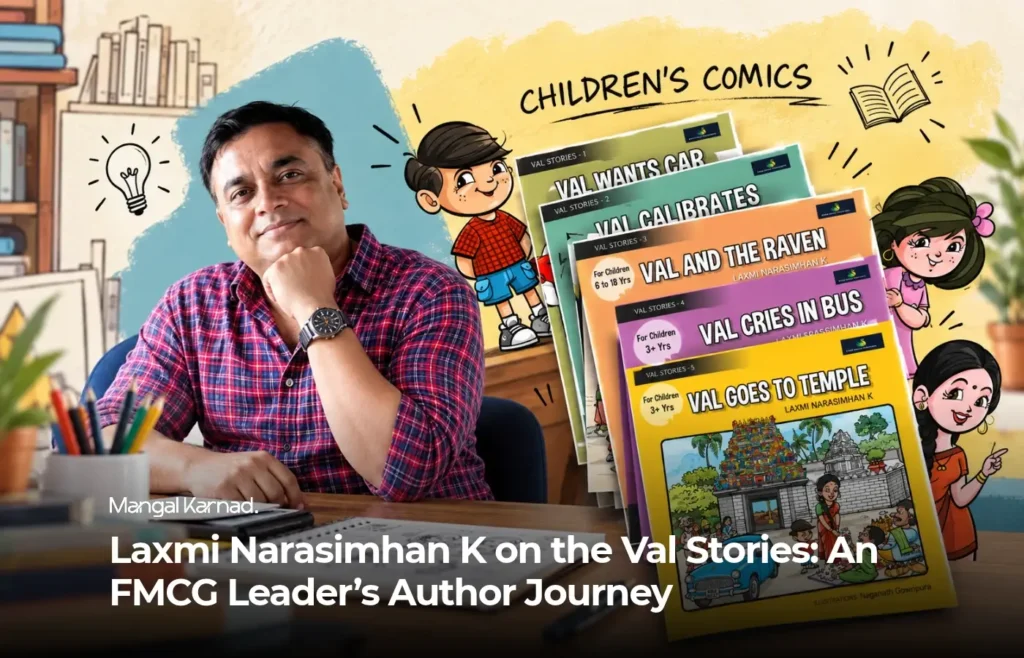
When a man who spent three decades running consumer-goods and spirits businesses, Coca-Cola India, Tata Motors and Diageo India, sits down to write a comic about a small boy waiting for a toy car, you pay attention.
Laxmi Narasimhan K is the industrial engineer and IIM Calcutta alumnus turned author, an authorpreneur behind the Val Stories, rooted in his own childhood on an Indian Air Force station in Bengaluru. Val stories are a self-published, full-colour children’s comic series, available in English, Hindi, Kannada and Braille, illustrated by Naganath Gowripura.
In this conversation for the Author’s Journey series, Laxmi Narasimhan talks about the moment dull corporate manuals first pushed him toward storytelling, what Amar Chitra Katha, Asterix and Indrajal taught him about the craft, why he chose to self-publish and build his own route to market, and the unsparing economics of getting a children’s book into readers’ hands. It is candid, unsentimental, and unlike most author interviews you will read.
The spark
You spent three decades running FMCG businesses worth thousands of crores. What was the specific moment that made you sit down and write a story about a little boy waiting for a toy car?
Around 2021, I was CEO and MD of a well-known company, and we had to create a lot of printed material: product dossiers, COBC booklets, POSH do’s and don’ts manuals, Marketing dockets, etc. As CEO, I would proofread for errors. I found the manuals bland and censorious, and on a whim delegated to rank youngsters to add illustrated captions to these corporate books to make them interesting to read while communicating the company ethos. I said the books should scream “Pick me up”, which they did splendidly. We quite enjoyed bringing out the literature. Then I thought if I could do it for the company, I could do one for my own journey.
You have described the Val Stories as a way of preserving memories of your childhood and of your father. Which memory came first? Did it arrive as a story, or as a feeling you then had to find a story for?
It all just blended in. Stories started first, then the characters took over, then their personalities came up. And then I felt, actually, it looks nice to remember my father and his stories in the comic book.
How much of Val is you? Where did you deliberately part ways with your own childhood?
I think I am still the same. I was a boy and son then; now I am also a man and a father. People remain the same. Our capabilities and skill sets may change. But our core personality doesn’t.
Your father and the Air Force world
In Val Wants Car, the father cannot keep his promise on time because duty comes first. Did writing that scene as an adult change how you see your own father?
I remember this story from what my parents recounted to me years later. They were very impressed by my consternation at their laziness. That even a child can call out Lackadaisicalness.
What does a child growing up on an Air Force station understand that other children may not?What did you want readers outside that world to feel?
Because my dad was a ranking officer, I understood a lot about hierarchy and protocols early on. And I think all armed forces kids are brought up on the staple diet that “Armed forces values “ are superior to “civilian values”. A lot of inculcation happens around manners and hard work.
Have your family and friends read the books? Was there a reaction (from them) that surprised or moved you?
Yes, they have. And they say nice things. Some also suggest improvements. But I note 50% only read when I give them for free. So that’s that. But the other 50% have talked with their wallet, which I value sincerely.
Choosing the comic form
You grew up on Amar Chitra Katha, Asterix and Indrajal. What did each of them teach you about telling a story?
Between the three of us siblings, we did back-to-back podium finishes in all 5 Delhi open ACK Quiz contests conducted by Anant Pai. He personally called my parents and us for tea at India Habitat Centre. Amar Chitra Katha also told stories that Irfan Habib and Romila Thapar left out. Through these comics, we discovered untold Indian history, mythology, and more.
Asterix is a work of art, and talking about Asterix impressed the panel in my IIM Calcutta interview.
Indrajal was pure entertainment and a flight of fancy, well written and plotted.
Why a comic? What does the format let you do, and what does it take away?
A Comic also closes out the imagination for you. I remember a picture of an Abhimanyu or Rani Durgavati from Comic books. The format should have fluidity of modes. Russian comic books never have that. Local Hindi comics also don’t pay attention to that. Champak has a very poor format.
Walk us through how a Val story moves from your head to Naganath’s panels. Do you script panel by panel, or hand over a story and let him interpret it?
Writing is the easier part. Bringing it to life is a group effort. Finding the illustrator took me about 3 years till I found Naganath. He and I can accomplish a lot because we calibrate well.
Yes, I script panel by panel because I learnt that’s how it needs to be communicated to the illustrator.
Teaching moral values without preaching
Your books carry boardroom-sized ideas. Such as “fallacy of thinking in isolation” and “for each to prosper, everyone must prosper.” How do you simplify them for a child?
Boardroom logic is often simple logic unless otherwise intended. Children understand simple logic very quickly and very well. But we also become prisoners of our foundation years. Once students lack foundation skills, they maintain a flat learning curve. So impart as much as you can early on. Once they ossify by the age of 20, precious little you can do.
Val is naughty. How do you decide how much mischief a story can hold before parents start to object?
Very good observation. I really cannot tell. So I show my wife and children first, and yes, I corrected myself before I made some bad mistakes.
Did you test drafts on children? Tell us about one thing a child said that made you change a story.
Never!
Henry Ford said, “Had I asked the customer what he wanted, he would have said, ‘a faster horse’”
From the boardroom to the blank page
Which skill from your corporate life helped you most as a writer, and which one did you have to unlearn?
Not really. I draft official letters, etc., which is very different from comic books. Nothing overlaps
As a business leader, you had teams, deadlines and PnL. As an author, you have a blank page and nobody to delegate to. What was hardest about working alone?
Yes !! In business, you are helped by an accomplished team that often corrects you and makes improvements. It is a team sport.
But alas, as an author, you are the first and last line of defence. Product development is one thing. But what surprised me was the utter indifference of even distribution channels to business success. They go through the motions.
How did your professional circle react when you told them you were writing children’s comics?
They say, “Where do you get the time?” I think people ‘doing stuff’ and people ‘doing time’ live on two different planets. My father used to say, “The busiest man has the most time”. I tell my friends that Mukesh Ambani and Mr Modi have the same 24 hours in a day, and look how much more they accomplish.
The publishing journey and its challenges
Why did you choose to self-publish? What did that decision give you, and what did it cost you?
I actually never understood the word “Publisher”. There is creation, printing, and distribution. You create, get it printed and put it through distribution. Even the distribution channel, unlike in FMCG, does not pay for merchandise. They take it pro bono, spread it around shops, and return all unsold stock. And if anything is sold, they take 50% of the MRP. It is actually a mug’s game. And the publisher solves nothing. What does he really do? So I decided to do everything myself.
You built distribution networks for some of the biggest consumer brands in India. How different is it to get a children’s book into readers’ hands? What surprised you most?
You have asked a very pertinent question, and you may find my answer very stark. Unlike FMCG/AlcoBev route-to-market partners, who pay for your goods and help move them into customers’ hands, bookstores don’t bother. They neither pay for merchandise nor allow you to train and incentivise their store team. They have a rent-seeking attitude. They have this incredible detachment from attempting anything that might actually work. I was disappointed that they blame Amazon for eating their lunch.
Full-colour comics are expensive to produce and price for children. How did you work through the economics?
Oh no !! Perish the thought!
There is a famous joke. “How do you make a billion dollars running an airline?” The answer is “Start with 2”
This space is of negligible size. There is no bacon here. For me, this is an experiment. Economics will never work.
My other cash surplus enterprises fund this handsomely and unconditionally. Hence, product quality is good, and stakeholders give their best because payments, touch wood, are not an issue. And why? Because there are so few economies of scale, even to have a respectable loss, to start a conversation around economics
There is no business imperative here, just a journey of discovery.
What has been the single biggest challenge in your journey as an author so far, and how are you dealing with it?
Having a Robust Route to Market and an advertising campaign.
Many professionals in their fifties carry a book inside them but never start. What would you say to them?
If you cannot sell 5000 copies, don’t write a book, for you are no author. It will be a cathedral to your ego, adorning your social media space and drawing-room conversations. That’s also fine, if that is what you seek.
Aliter, if you cross 5000, please teach me what it takes. I have only done 2000.
You have published them in multiple languages (English Original, Hindi, and Kannada), and in Braille. Which language is received best?
Braille is the best. I distribute through Mitra Jyoti. They are very professional and work as a partner. Demand is also higher here.
You can buy Val Comic Series from here: https://valbooksstore.com/
@ Laxmi Narsimhan K :
Amazing!! ❤️ I’m so happy that you’re writing to express your thoughts and reaching out to as many people as possible. Braille books are absolutely spot on! 🎯
Blessings to you and your beautiful endeavour. 🙏❤️
Thank you, Mangal for conducting this interview. ❤️