
Memory and Loss of a Child: What the World Forgets After a School Shooting
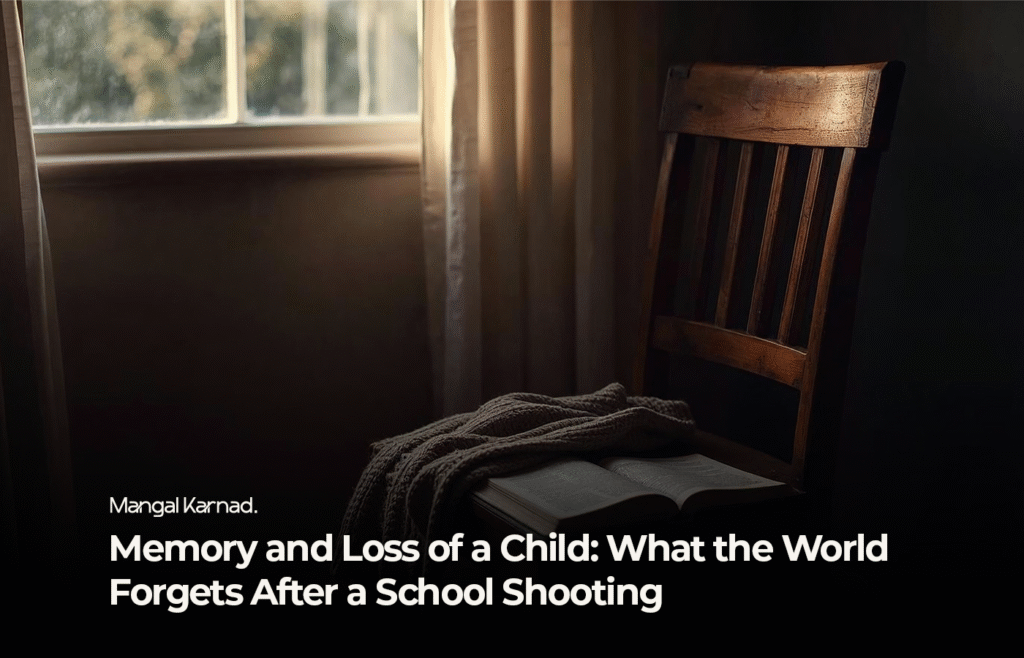
Memory is rarely passive. For most of us, it arrives on its own unbidden, involuntary, catching us off guard. But for those who have experienced the memory and loss of a child, remembering becomes something else entirely: an act of will, a daily and deliberate effort to hold on to someone the world has already moved on from. It is that kind of memory effortful, resistant, kept alive against the current that has always compelled me as a writer. And it is that kind of memory I encountered recently in a documentary that stayed with me even after I finished watching.
Recently I watched a documentary on Netflix titled *All the Empty Rooms*. The documentary was created by CBS News correspondent Steve Hartman and photographer Lou Bopp. Over a period of seven years, they travelled across the United States documenting the bedrooms of children who were killed in school shootings.
Both Hartman and Bopp are fathers. Their documentary focuses on the family’s reflections and their attempt to preserve the memory of the child; it avoids details of the incident.
It documents the children who lost their lives and the families who continue to live with that loss.
For many years, Steve Hartman had been known as the “feel-good” reporter. According to Netflix, the documentary shows how the journalist and photographer sought to honor the memories of children lost to school shootings, often offering hope and resilience through stories that remember them, during overwhelming grief. As school shootings continued to occur year after year, he began to feel that something important was missing from the way these tragedies were covered.
The shooters were discussed endlessly. Their names circulated widely in news reports and online conversations. Meanwhile, the children who lost their lives slowly became numbers within larger statistics. Hartman says he realized the children were not being remembered as they should be.
How Families Preserve the Memory of a Child
The documentary takes viewers into the homes of families who lost their children. Many parents have preserved their child’s room exactly as it was on the day the child left for school.
The bed remains made in the same way. Clothes remain in cupboards. Books remain on desks. In some homes, even the lights remain on exactly as the child left them.
Parents enter those rooms every day. Some of them say good morning to the child.
Some say good night. Some lie down on the bed and cry. Some sit quietly and talk to the child. According to a report from Netflix Tudum, families featured in the documentary often speak about the deep silence that fills their homes after losing a child, expressing a longing for the simple presence, familiar sounds, and physical closeness they remember. They want to smell the child again. But they cannot. The room becomes the closest thing they have left.
Grief After Losing a Child: Choosing to Remember
What strikes me most is that none of this is accidental. These parents are not simply unable to let go. They are making a choice, every single day, to remember. The preserved room, the lights left on, the good morning said to an empty bed these are not symptoms of grief. They are acts of devotion. They are the only form of care still available to them. And the loss is made more unbearable by the knowledge that their child’s life was taken by another person’s deliberate act. According to a Netflix Tudum feature on the documentary ‘All the Empty Rooms,’ the loss experienced by families in school shootings is different from deaths caused by illness or accidents because it results from someone’s deliberate choice rather than a natural or expected event. That knowledge never leaves
When the News Moves On: The Enduring Grief of Families
Watching these families makes something very clear. When a child dies in a violent incident, the loss does not end when the news cycle ends.
When such a tragedy occurs, the media covers it intensively for a period of time. There are breaking news alerts, repeated footage, interviews, and analysis. For days or weeks, the event dominates headlines.
Then gradually it becomes a smaller update. Then a brief mention. Eventually, it disappears from public attention.
But for the families, nothing disappears.
For them, time stops at the moment their child died.
The rest of the world continues to move forward, but the parents remain in a place where the same questions repeat endlessly.
For many parents, the grief comes attached to questions that have no one left to answer them.
What if the conversation we had that morning had been different?
What if I had told them once more how proud I was of them?
Parents may also struggle with the question, ‘Why did this happen to my child?’
There is no explanation that can make such a loss understandable.
The Lasting Impact of Losing a Child on the Whole Family
The impact does not end with the parents. Siblings grow up with an absence that never changes. Birthdays, graduations, and family gatherings carry the presence of someone who should have been there but never will be.
The child who died will never grow older. They will never graduate, never build a career, never fall in love, and never create a family of their own.
Every year that passes makes that absence more visible.
The Morning Photo: When Ordinary Memories Become the Last
One moment in the documentary is particularly striking. Hartman speaks about what he calls the “morning photo.” Many parents had taken casual photographs of their children on the morning they left for school ordinary images, taken without much thought, of a child picking up a bag or heading out the door. For some of the families in this film, that photograph became the last one ever taken of their child. A routine morning became the final memory of a child.
Hartman’s intention in creating *All the Empty Rooms* was to remind people that behind every statistic there was a child with a life that had barely begun. According to CBS News, Steve Hartman and Lou Bopp photographed the bedrooms of children killed in school shootings, creating individual picture books for each family. Their purpose was not to create spectacle or emotion for television but to honor the memory of the children for their families. It was to acknowledge that these children existed and that they mattered.
Why Memory Matters: What This Documentary Teaches Us
The documentary left me with an important realisation. Society can move on quickly from tragedy. News cycles change. Attention shifts. Other stories take priority.
But families who lose a child can not move on. They must learn to live with the loss.
For the rest of the world, the tragedy becomes part of the past, but for the family, it remains part of every day that follows.
What the documentary ultimately leaves behind is a deeper understanding of what memory means when a child is lost, and for the families, memory becomes the only place where the child continues to exist.
Watching these families in *All the Empty Rooms*, I recognised something I have been trying to write about for a long time: that the people we love do not simply disappear. They persist in the rooms kept for them, in the lights left on, in the good mornings said to no one and to someone at the same time.
Memory is not always gentle.
Sometimes it is warm, comforting, and sustaining. Sometimes it is the quiet thread that keeps a person connected to who they were and who they loved. But sometimes memory is heavy. It sits in the chest like a stone. It asks to be carried long after everyone else has moved on.
My own memories are of good times; of family, of belonging, of ordinary moments that I did not know then I would one day hold so carefully. The people I shared those times with are no longer here. There are regrets, as there always are. But what I choose to carry is not the loss — it is the warmth of what we had. Memory, for me, is less a stone and more a room I can still walk into.
If you are drawn to stories about memory, loss, and the lives we carry forward, my books explore these themes through the lens of ordinary lives in coastal Karnataka. You can read more about my work at mangalkarnad.com.