
Why Children’s Story Books Still Matter
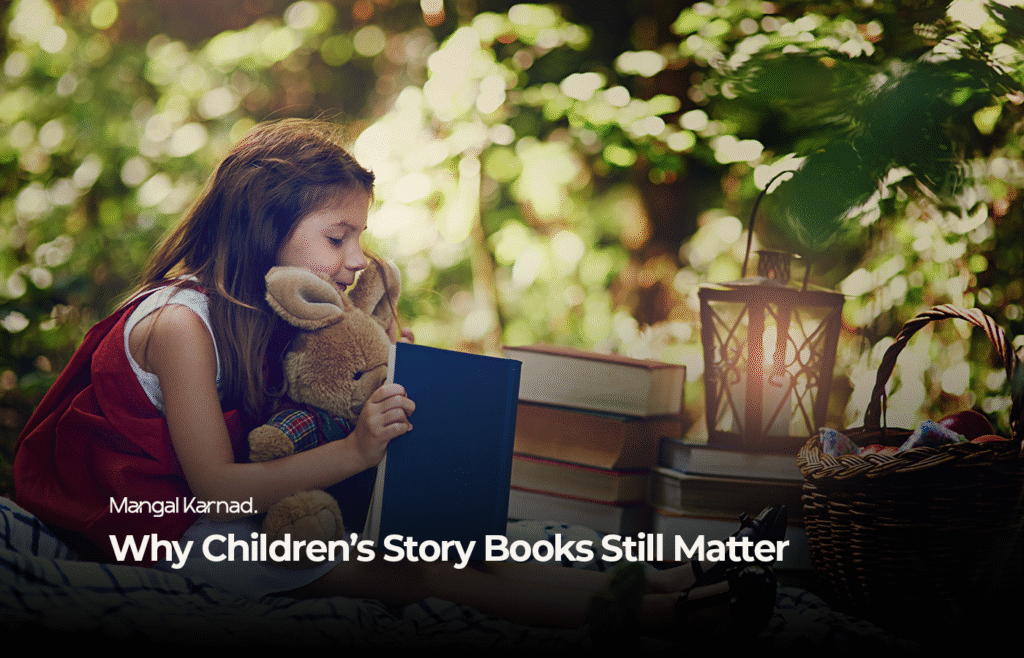
How Stories Shape Learning, Empathy, and a Child’s Inner World
Most of us remember a story from childhood long after we forget lessons, rules, or instructions.
It might be a bedtime story read softly under a blanket.
A short tale told by a grandparent, half-remembered but deeply felt.
A book borrowed from a school library, returned late because it was read again and again.
Children’s storybooks stay with us because they do something rare.
They speak to the inner world of a child.
In a time when childhood is increasingly busy, scheduled, and screen-filled, stories remain one of the gentlest and most powerful ways children learn about language, emotions, relationships, and themselves.
This page is written for parents, educators, librarians, bookstores, and anyone who believes that stories still matter, not as nostalgia, but as a living, breathing part of a child’s education.
Stories Are How Children First Understand the World
Children do not learn the way adults do.
They do not separate facts from feelings.
They do not absorb meaning through instruction alone.
They learn through imagination, repetition, and emotional connection.
Stories bring all of this together.
When a child listens to a story or reads one on their own, they are doing much more than following a plot. They are noticing patterns. They are predicting what might happen next. They are absorbing new words without effort. They are learning how cause and effect work, not in theory, but in lived experience.
This is why children often ask for the same story again and again. Each reading offers something new. Each return deepens understanding.
Research in early education has consistently shown that storytelling supports language development, memory, and comprehension. Studies shared by the Harvard Graduate School of Education point to how narrative exposure strengthens a child’s ability to sequence ideas and understand meaning in context. But any parent or teacher who has watched a child lost in a story already knows this instinctively.
Stories work because they feel natural.
Indian research echoes what parents and teachers have long observed intuitively. A study on primary school children in India found that storytelling plays a significant role in strengthening foundational literacy, including vocabulary, comprehension, imagination, and cultural understanding. The research highlights how stories, especially when told or read aloud, help children grasp language naturally and meaningfully, rather than through rote instruction. You can read the study here: The role of storytelling in enhancing foundational literacy among primary school children in India.
Why Listening to Stories Is Just as Important as Reading
Before children learn to read on their own, they learn by listening.
Listening to stories builds attention, patience, and imagination. Unlike visual media, stories ask children to create pictures in their own minds. A forest, a classroom, a feeling of fear or joy, all of it is imagined, not supplied.
When a story is read aloud, something else happens too. A relationship forms around the story.
A parent’s voice.
A pause before the ending.
A question was asked mid-sentence.
These moments matter.
Shared reading has been shown to support not only literacy, but emotional security and bonding. The American Academy of Pediatrics has highlighted how reading aloud strengthens connection and helps children regulate emotions.
This is why short stories for kids read aloud remain so effective in homes and classrooms. They create shared attention in a distracted world.
Storytelling at Home: More Than a Habit
When parents or caregivers tell or read stories to children, they are offering more than entertainment.
They are offering presence.
Storytime becomes a pause in the day. A predictable, calming ritual. A space where a child feels seen and heard.
Children often return to stories for comfort, not just curiosity. A familiar story read by a familiar voice becomes a safe place. Over time, this builds trust, emotional security, and openness.
Storytelling does not require special skill. It does not require voices or drama. What it requires is attention.
A quiet, unhurried reading often leaves the deepest impression.
How Stories Nurture Empathy
One of the quiet gifts of children’s story books is empathy.
Through stories, children step into lives that are not their own. They experience feelings they may not yet have words for. They begin to understand that others think, feel, and struggle differently.
Empathy cannot be taught through instruction alone. It grows through experience.
Narrative research shared by the Greater Good Science Center at UC Berkeley explains how stories help readers practise perspective-taking and emotional recognition. For children, this means learning kindness, fairness, and compassion not as rules, but as lived understanding.
A well-told story does not announce its lesson.
It lets the child discover it.
Morals Without Preaching
Many adults look for short moral stories in English for children, hoping to pass on values. The challenge is that children resist being taught what to think.
They do not resist understanding.
Stories that work best are those where morals emerge naturally. A character makes a choice. Something changes. The child notices.
A story about honesty works because dishonesty has consequences.
A story about kindness works because kindness shifts a moment.
Through this, children learn not just what is right or wrong, but why actions matter.
This kind of learning lasts.
Stories in Schools and Libraries
In classrooms and libraries, stories act as bridges.
They help children approach complex ideas gently.
They support inclusion and emotional learning.
They open conversations that facts alone cannot.
Teachers and librarians often find that the best children’s story books are the ones that spark discussion after the reading ends. That conversation is where reflection begins.
Short stories for kids, in particular, offer achievable reading experiences. They build confidence and encourage independent exploration.
Stories do not replace curriculum. They humanise it.
In many classrooms, children’s story books become the starting point for deeper thinking and dialogue.
Traditional Storytelling in a Modern World
Formats have changed, but the heart of storytelling has not.
Printed books still offer something irreplaceable: focus, touch, and shared reading. Sitting beside a child with a physical book creates a different kind of presence.
At the same time, Kindle and ebooks have made children’s story books more accessible, especially for families and schools with limited physical resources. When used thoughtfully, digital formats can support reading without replacing connection.
Audio stories can also play a role, especially when listened to together. However, solitary listening should not replace human-led storytelling in early childhood.
The medium matters less than the intention. What children need most is not speed or novelty, but attention.
Why Stories Stay With Us
Many adults can recall a childhood story long after forgetting school lessons. This is because stories lodge themselves in memory through emotion.
Stories help children:
- Make sense of their feelings
- Understand relationships
- Build resilience
- Develop a lifelong relationship with reading
Over time, children’s story books become part of a child’s internal voice and memory.
Children who grow up surrounded by stories often carry that habit into adulthood. They seek meaning through books. They listen more closely. They imagine more freely.
That is no small thing.
Choosing Children’s Story Books with Care
Not all stories are equal, and not all stories need to teach.
When choosing children’s story books, look for stories that:
- Respect a child’s intelligence
- Allow space for imagination
- Reflect a range of experiences
- Do not rush emotional moments
The best children’s story books do not shout. They stay.
Frequently Asked Questions
From infancy. Even before children understand words, they absorb rhythm, warmth, and connection.
Yes. Printed books support focus, shared reading, and sensory connection.
Yes, when morals are woven gently through story rather than delivered as instruction.
Both matter. Short stories build confidence and attention, while longer books deepen engagement.
They give children safe spaces to explore feelings through characters and situations.
Consistency matters more than duration. A few minutes daily is enough.
A Quiet Closing Thought
Stories ask us to slow down.
To sit beside a child.
To read aloud.
To listen together.
Children’s story books are not just tools for learning. They are invitations to connection.
When we choose stories with care and read them with attention, we offer children something lasting. A way to understand the world, and their place within it.
A Note from the Author
I grew up listening to stories long before I learned to read them.
In Mulki a small town, stories arrived in many forms and from many voices. They were told quietly at home by parents and grandparents, and shared aloud in community spaces. We heard stories from the Shiva Purana and the Mahabharata, fables from the Panchatantra, and stories drawn from lived experience, small incidents, lessons learned the hard way, moments of courage, loss, humour, and kindness.
Stories were not always announced as stories. Sometimes they came wrapped in advice. Sometimes in memory. Sometimes in reflection.
Beyond the home, storytelling lived all around us. We watched bombeyata (puppet shows), listened to Harikatha, and grew up with the colours, music, and drama of Yakshagana. These were not “performances” set apart from life. They were part of how values, history, and imagination were passed on.
Looking back, I realise that this constant presence of stories shaped how we listened, how we understood people, and how we learned to make sense of the world. Stories were never just entertainment. They were how meaning travelled.
That early immersion continues to influence how I think about children’s story books today, not as products or tools, but as living bridges between generations, emotions, and understanding.